
Our Blog
The Truth Behind the “25% Tax” on Buying a Home:
-
 By Atharvlifestyle
 -
 February 18, 2026
 -
 Uncategorized
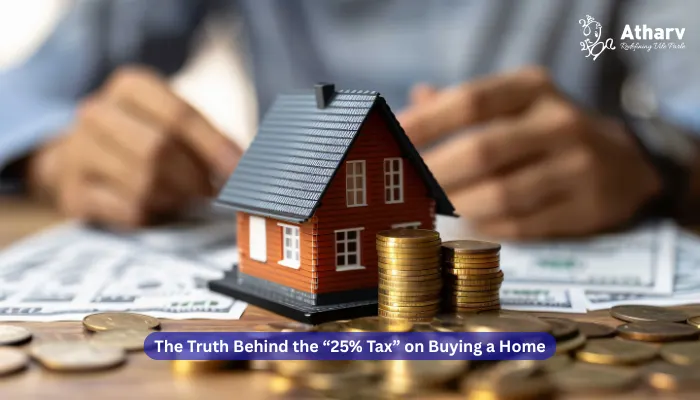
Is the Government Taking More Than It Gives Back?
Buying a home in India is often described as a milestone. But here’s the uncomfortable question:
Are homebuyers silently paying over 25% of their property value in taxes and government levies — and getting little in return?
Let’s break it down.
The Hidden 25%: Where Does Your Money Actually Go?
When you see a property advertised at ₹1 crore, you assume that’s the cost of the home. But is it really?
By the time you complete the purchase, a significant chunk of your payment goes not to the developer — but to the government.
1️⃣ GST (Goods and Services Tax)
For under-construction properties:
- 1% GST for affordable housing
- 5% GST for other residential properties
Why should buyers pay GST on a home — a basic necessity — when ready-to-move properties are exempt? Isn’t this creating artificial pricing distortion?
2️⃣ Stamp Duty & Registration (5%–10%)
This is a state-level tax paid at the time of registration.
In states like Maharashtra, Karnataka, Haryana, and others, buyers pay around 5% to 7% stamp duty plus registration charges.
Ask yourself:
If property prices have already appreciated massively, why is stamp duty still percentage-based instead of capped?
On a ₹1 crore property, this alone can mean ₹6–8 lakhs.
3️⃣ Development Charges (EDC/IDC)
External Development Charges (EDC)
Infrastructure Development Charges (IDC)
Developers pay these to authorities — but ultimately, the cost is passed on to buyers.
These charges are meant to fund:
- Roads
- Sewage systems
- Drainage
- Utilities
But if you are paying for infrastructure upfront…
Why are flooded roads and traffic chaos still the norm in cities like Mumbai, Bengaluru, and Gurgaon?
4️⃣ Betterment & Civic Charges
In many developing micro-markets, civic bodies levy additional “betterment” charges.
The logic: “We will improve the area.”
The reality many buyers experience:
- Broken footpaths
- Poor waste management
- Waterlogging during monsoons
So the question remains:
Is this development charge or double taxation?
The Bigger Question: What Are Buyers Getting in Return?
In cities like Mumbai, Bengaluru, and Gurgaon, homebuyers pay:
- High stamp duty
- GST
- Development charges
- Property tax annually
Yet:
- Urban flooding continues
- Traffic congestion worsens
- Public transport expansion is slow
- Civic amenities lag behind global standards
Is it unreasonable for buyers to ask:
Where is the accountability for this 25%?
It Doesn’t End at Purchase: Taxes When You Sell
Even after paying heavy entry costs, the tax cycle continues.
Long-Term Capital Gains (LTCG)
- 12.5% without indexation (for recent changes)
- 20% with indexation (for older acquisitions, as per applicable rules)
Short-Term Capital Gains (STCG)
If sold within 24 months, gains are added to your income and taxed at your slab rate.
So effectively:
- You pay tax when buying.
- You pay property tax while holding.
- You pay capital gains tax when selling.
Is homeownership being treated as wealth creation — or revenue generation for the state?
The Real Impact on Returns
Because of these layered taxes:
- Entry cost increases significantly
- Rental yields in major Indian cities remain around 2–3%
- Real appreciation often struggles to beat inflation after taxes
So here’s the uncomfortable math:
If 25% goes in taxes and charges, and rental yields are modest,
Are homebuyers truly investing — or just locking capital in an overtaxed asset?
A Question to the Government
Housing is not a luxury. It is a basic human need.
Then why is:
- There is no input tax credit benefit for end buyers?
- Stamp duty not rationalised nationwide?
- Development charges not transparently audited?
- Infrastructure delivery not directly linked to collected funds?
If citizens are paying premium taxes, shouldn’t they receive premium infrastructure?
The Way Forward
Rather than discouraging homeownership with layered taxation, policy could:
- Rationalise stamp duty across states
- Improve transparency in development charges
- Link infrastructure timelines to funds collected
- Offer greater tax relief for primary residence buyers
A stronger housing ecosystem benefits:
- Government (through broader tax base)
- Developers (through higher demand)
- Buyers (through better returns and quality of life)
Final Thought
The “25% tax on buying a home” isn’t a myth. It’s a structural reality in many Indian cities once all levies are added up.
The real question is not whether taxes exist.
The real question is:
Are homebuyers getting fair value for the taxes they pay?
Connect with Atharv Lifestyle to make a smarter and more informed homebuying choice.