Our Blog
Shivaji Park, Dadar: What a Sea-Facing Address Actually Costs and Why
-
 By Atharvlifestyle
 -
 August 24, 2026
 -
 Blog
Blog
Ask what a home at Shivaji Park costs and you will be quoted a rate per square foot. That number is the smallest part of the answer.
Between the rate a broker quotes and the amount that actually leaves your account sit stamp duty, GST, registration, a lifetime of property tax, monthly maintenance on common areas you have not yet seen, and if you are borrowing an interest bill that can rival the price of the flat itself. Alongside those are the costs that never appear on a price list at all: tighter carpet areas than the suburbs, scarcer parking, older building stock, and the upkeep that salt air quietly demands of a sea-facing home.
This article puts numbers to all of it, sourced and dated, so you can work out what a Dadar West address really asks of you and decide whether the thing it gives back is worth it.
The headline number first
Apartments in the Shivaji Park pocket of Dadar West are currently listed in a band of roughly ₹39,800 to ₹70,650 per sq ft (NoBroker locality data, rates stated as of December 2025), with a locality average asking rate of about ₹55,400 per sq ft (99acres locality price trends, August 2026). Premium and sea-facing towers in the wider Dadar West market have transacted materially higher — recent high-end societies here range from around ₹62,500 to ₹97,350 per sq ft (99acres, August 2026).
| Configuration | Typical carpet area | Indicative price band |
|---|---|---|
| 2 BHK | 650–750 sq ft | ₹3.4 – ₹4.2 Cr |
| 3 BHK | 950–1,200 sq ft | ₹5.3 – ₹7.5 Cr |
| 3 BHK (large / sea-facing) | 1,300+ sq ft | ₹9 Cr and upwards |
| 4 & 5 BHK / whole-floor | 2,000+ sq ft | On request |
Based on live listings for Shivaji Park and Dadar West, July–August 2026.
Actual listed units in the precinct give a clearer feel than averages do:
| Unit | Carpet area | Quoted price | Works out to |
|---|---|---|---|
| 2 BHK, under construction | 729 sq ft | ₹3.50 Cr | ~₹48,000 / sq ft |
| 2 BHK, under construction | 687 sq ft | ₹3.78 Cr | ~₹55,000 / sq ft |
| 3 BHK, under construction | 972 sq ft | ₹5.35 Cr | ~₹55,000 / sq ft |
| 3 BHK, under construction | 1,346 sq ft | ₹9.46 Cr | ~₹70,300 / sq ft |
| 4 & 5 BHK / whole-floor | 2,000+ sq ft | — | On request |
Individual listings on public property portals, August 2026. Per-sq-ft figures derived from quoted price divided by stated carpet area. All figures indicative and subject to change — verify current pricing directly with the developer or seller.
The number most buyers miss: asking price vs registered price
Here is the data point that should change how you negotiate.
Across Shivaji Park, the average asking rate is about ₹55,400 per sq ft, while the average rate at which flats are actually registered sits closer to ₹45,536 per sq ft (99acres, August 2026, registered rates compiled from Maharashtra state revenue authority records). Across the wider Dadar West market the same gap appears: about ₹53,400 asking against ₹42,014 registered (99acres, August 2026).
That is a gap of roughly 18–21%. It is not a discount you should expect on every deal — it reflects older society stock registering lower, floor-rise and view differences, and the ordinary distance between an ask and a close. But it does tell you that in a resale transaction here, the listed rate is a starting position. In a new-launch boutique tower with genuinely scarce product, it usually is not.
Worth noting: Shivaji Park has outperformed the wider Dadar West market over the past year, at roughly 10.1% appreciation against 1.5% for Dadar West as a whole (99acres, August 2026). Location within Dadar matters as much as Dadar itself.
What the government says it is worth
Separately from the market, the Maharashtra government sets a floor value for every zone — the Ready Reckoner (RR) rate, published in the Annual Statement of Rates.
For the zone covering Shivaji Park, Dadar West, Dadar East and Hindu Colony, the residential ASR sits at approximately ₹1,60,000 to ₹2,20,000 per sq m, or roughly ₹14,900 to ₹20,400 per sq ft (Annual Statement of Rates 2025–26, Department of Registration and Stamps, Government of Maharashtra).
Two caveats before you compare that to market rates:
- RR rates apply to built-up area, not carpet area. Market rates above are quoted on carpet. The two are not directly comparable.
- The RR rate is a legal floor, not a valuation. Mumbai property routinely trades well above it.
The RR rate matters more than most buyers realise, because it drives three separate costs at once: stamp duty when you buy, property tax every year you own, and capital gains when you sell. For your specific building, look up the exact figure on the IGR Maharashtra e-ASR portal using the property’s CTS or survey number.
Good news for 2026: Maharashtra has frozen RR rates for FY 2026–27. They were last revised on 1 April 2025, when Mumbai saw a 3.39% increase; no revision was announced this April (Office of the Inspector General of Registration, Maharashtra, April 2026). All three of those costs stay flat this financial year.
Cost one: what you pay at registration
The per-sq-ft rate is not the landed cost. Budget for the following, all calculated on the higher of your agreement value or the Ready Reckoner value:
| Head | Rate (Mumbai, FY 2026–27) |
|---|---|
| Stamp duty – sole male buyer, or joint male + female | 6% (5% base + 1% Metro Cess) |
| Stamp duty – sole female or all-female buyers, residential only | 5% (4% base + 1% Metro Cess) |
| Registration charges | 1%, capped at ₹30,000 for properties above ₹30 lakh |
| GST – under-construction, non-affordable | 5%, without input tax credit |
| GST – ready possession, OC received | Nil |
Stamp duty, Metro Cess and registration as per the Maharashtra Stamp Act schedule and IGR Maharashtra; GST as notified for residential real estate.
Worked example on a ₹5 crore agreement value:
| Under construction | Ready possession (OC received) | |
|---|---|---|
| Stamp duty @ 6% | ₹30,00,000 | ₹30,00,000 |
| Registration | ₹30,000 | ₹30,000 |
| GST @ 5% | ₹25,00,000 | Nil |
| Total over and above price | ₹55,30,000 (~11%) | ₹30,30,000 (~6%) |
That 5% GST difference is worth ₹25 lakh on a ₹5 crore home. It is one of the few genuinely large levers a buyer controls in this market.
Two smaller heads that catch people out: 1% TDS is deductible on any property above ₹50 lakh and must be deposited against the seller’s PAN, and brokerage on a resale transaction typically runs 1–2% of value. Neither is optional, and neither is in the quoted rate.
Cost two: what you pay to finance it
If you are borrowing, interest is usually the single largest number in the whole exercise — larger than stamp duty, GST and a decade of maintenance combined.
Home loan rates from leading Indian lenders currently start at around 7.25% and run to roughly 8.45% per annum, depending on credit profile, loan amount and employment type (published lender rates, August 2026). Most lenders offer a marginal concession, typically around 0.05%, where a woman is the primary owner or co-applicant.
What that means in practice: a ₹2.5 crore loan at 8% over 20 years works out to an EMI of roughly ₹2.09 lakh a month, and around ₹2.5 crore in total interest. You repay close to twice what you borrowed.
This is why the buyer profile at Shivaji Park skews low-leverage. At this price point, the difference between a 40% loan and a 70% loan is measured in crores over the tenure, not lakhs.
Cost three: what you pay every year you own it
The recurring costs are small next to the purchase price and easy to ignore at the point of sale. Over a twenty-year hold, they are not small at all.
Property tax. BMC uses the Capital Value System: capital value is derived from the Ready Reckoner rate, carpet area, construction type, age of building, floor and usage, and the residential tax rate runs between 0.316% and 0.726% of capital value (BMC, rates effective 1 April 2025). Older buildings get a depreciation benefit; higher floors are weighted up; residential units of 500 sq ft carpet or less are fully exempt. For a large flat in this zone, expect an annual bill in the tens of thousands of rupees rather than the low thousands. Calculate yours exactly at ptaxportal.mcgm.gov.in and note the 10% early-bird discount for paying before the May deadline, and the 2% per month penalty after the June cut-off.
Society maintenance. Mumbai societies typically charge between ₹4 and ₹15 per sq ft per month, with premium and boutique buildings running higher (NoBrokerHood, 2026). On a 1,000 sq ft carpet flat that is roughly ₹4,000 to ₹15,000 a month before extras. Where maintenance exceeds ₹7,500 per member per month and the society crosses the turnover threshold, 18% GST applies on top. Sinking fund and major-repair contributions sit alongside this.
Salt air. A genuine sea-facing home in Mumbai costs more to keep than an inland one. Window fittings, railings, external paint and air-conditioning condensers all corrode faster within sight of the water. It is not a large number annually, but it is a real one, and it is worth asking a prospective society what its repainting and waterproofing cycle actually is.
Cost four: the trade-offs that have no price tag
Not every cost is a payment. Buying at Shivaji Park means accepting several things the suburbs would not ask of you.
- Carpet efficiency. Rupee for rupee, you get materially less floor area here than in Wadala, Chembur or Andheri. That is the deal.
- Parking. Dadar is one of Mumbai’s most parking-constrained neighbourhoods. Confirm exactly how many covered spaces come with the unit and whether a second car is allotted or leased — it is not a given.
- Age of stock. Much of the resale inventory is in buildings several decades old. Check the society’s structural audit, redevelopment status and any pending cess or repair liability before you commit.
- Density and traffic. This is a central, busy, extremely well-established neighbourhood. The maidan is calm. The roads around it, at peak hours, are not.
None of these are reasons not to buy here. They are the things worth pricing in with open eyes, because they will not be volunteered in a site visit.
What it gives back
Two numbers on the other side of the ledger.
Rental yield. Shivaji Park delivers an average rental yield of around 5%, against roughly 3% for Dadar West as a whole (99acres, August 2026). In a city where prime residential yields commonly sit in the 2–3% range, that is unusually strong. Rentals here span roughly ₹40,000 to ₹2,50,000 a month for 1 to 3 BHK homes (NoBroker, as of December 2025).
Appreciation. Roughly 10.1% over the last twelve months, against 1.5% for Dadar West overall (99acres, August 2026).
Put simply: the holding cost is real, but so is what the address returns.
Why it costs what it costs
Five things are doing the work.
1. Supply is structurally fixed
Dadar is fully built out. There is no land bank here. Every new project in the precinct is a redevelopment of an existing society, which means fresh apartments in Dadar arrive in small batches of 20–40 units, years apart. When supply cannot expand in response to demand, price does the adjusting.
2. The view is protected, not just present
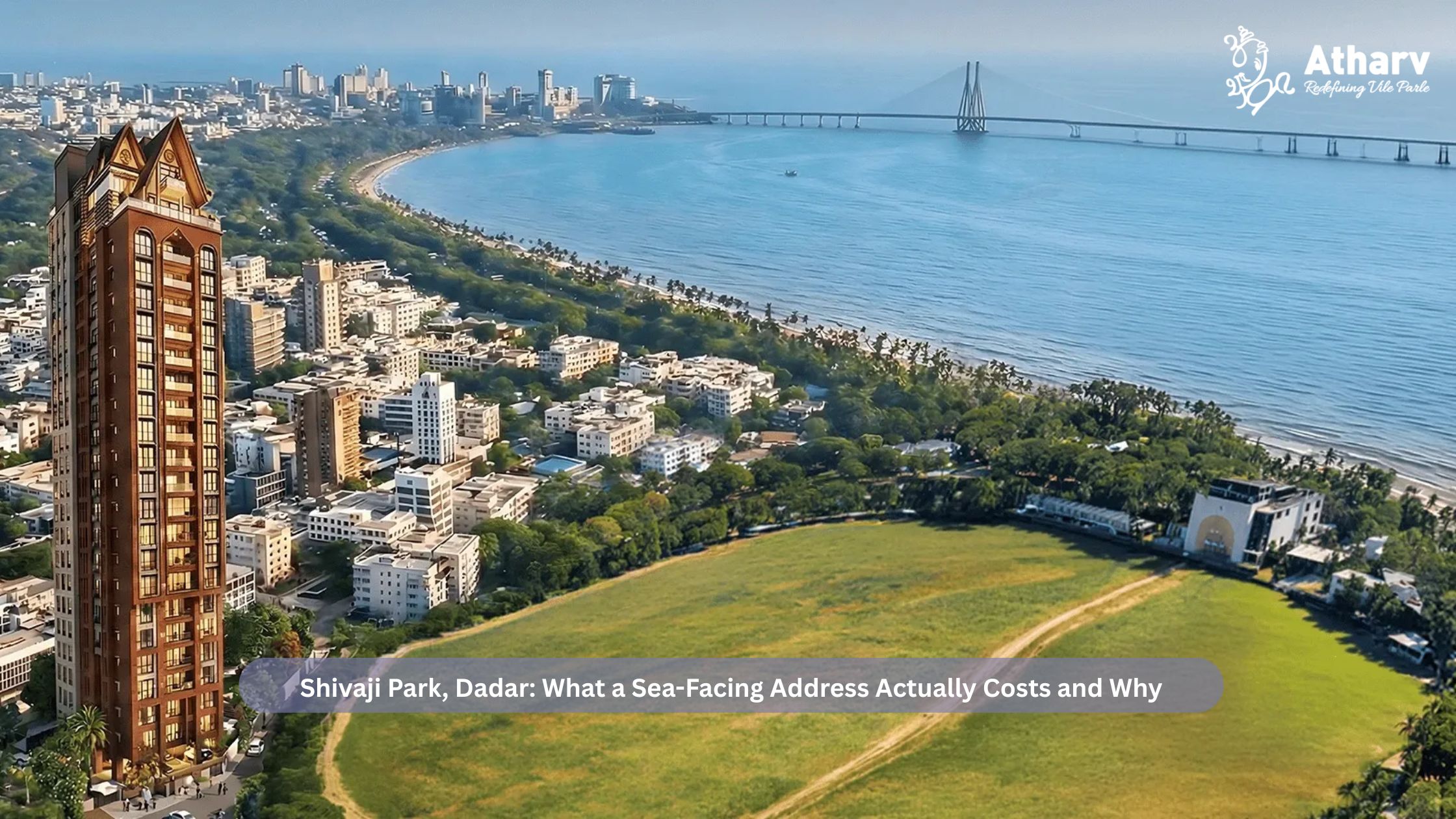
This is the biggest single driver of the premium, and the most misunderstood. A sea-facing flat in most of Mumbai stays sea-facing until the next tower goes up in front of it. At Shivaji Park the foreground is Chhatrapati Shivaji Maharaj Park, a protected public maidan, and beyond it, the coastline toward the Bandra–Worli Sea Link. Neither can be built over.
So what a buyer pays for here is not a view; it is a view with no obstruction risk attached. That is what justifies the delta over an equivalent flat two streets inland.
3. Connectivity was repriced in 2025
Dadar has always had both the Western and Central railway lines. What changed is the Metro. Mumbai Metro Line 3 (the Aqua Line) opened its Dadar and Siddhivinayak stations on 10 May 2025, and the full Cuffe Parade–Aarey corridor became operational in October 2025 (Mumbai Metro Rail Corporation).
That put BKC, Worli, Lower Parel, Nariman Point and the international airport on a single underground line from the neighbourhood’s doorstep. Dadar West was already central; it is now central and metro-connected.
4. The buyer here is not price-led
Demand comes from three groups: long-time Dadar residents upgrading within the same neighbourhood, NRIs buying a legacy Mumbai address, and South Mumbai buyers wanting open space without leaving the core. These are largely low-leverage, decision-ready buyers who compete on availability rather than on rate.
5. Large formats are the scarcest thing in the market
Old Dadar stock is dominated by compact 1 and 2 BHK layouts. A 3, 4 or 5 BHK with a genuine sea aspect is rare, and low-density – a single residence per floor, private lobbies, no shared landings barely exist here at all. Scarcity within scarcity carries its own premium.
So is it worth it?
That depends entirely on what you are buying it for.
If you want maximum carpet area per rupee, Shivaji Park is not the answer and never has been. Wadala, Chembur or Andheri will give you more square feet for the same cheque, with easier parking and newer buildings.
If you want a central Mumbai address with a permanent open-space frontage, two suburban rail lines, a metro station, a 5% yield and supply that structurally cannot expand — then the pricing is less a premium than the market clearing rate for something there is no more of. Buyers tracking flats for sale in Dadar at this end of the market are generally not comparing it to the suburbs; they are comparing it to Worli and Prabhadevi, and finding the maidan is not available at any price elsewhere.
Frequently asked questions
What is the current property rate in Shivaji Park, Dadar?
Listings in Shivaji Park range from approximately ₹39,800 to ₹70,650 per sq ft in asking terms, as of mid-2026. Registered transaction rates average closer to ₹45,536 per sq ft (99acres and NoBroker locality data).
How much does a 3 BHK cost in Shivaji Park?
A 3 BHK of roughly 950–1,200 sq ft carpet typically ranges from ₹5.3 crore to ₹7.5 crore. Larger sea-facing 3 BHKs above 1,300 sq ft carpet have been listed at ₹9.46 crore (live listings, August 2026).
What are the total costs of buying a flat in Dadar beyond the price?
On a ₹5 crore purchase, budget roughly 11% extra for an under-construction home (6% stamp duty, ₹30,000 registration, 5% GST) or about 6% for a ready-possession home with OC. Add 1% TDS, brokerage of 1–2% on resale, and then annual property tax and society maintenance for as long as you own it.
How much is society maintenance in a Mumbai building?
Typically ₹4 to ₹15 per sq ft per month, higher in premium and boutique buildings, with 18% GST applicable above ₹7,500 per member per month subject to the society’s turnover.
Is a sea view at Shivaji Park permanent?
Largely yes. The maidan is a protected open ground and the coastline beyond it cannot be built over, which removes the obstruction risk affecting most sea-facing flats elsewhere in Mumbai.
What is the stamp duty on a flat in Dadar?
6% for male and joint buyers, 5% for sole or all-female residential buyers, both inclusive of the 1% Metro Cess. Registration is 1%, capped at ₹30,000. Both are charged on the higher of agreement value or Ready Reckoner value (IGR Maharashtra).
Have Ready Reckoner rates increased in 2026?
No. Maharashtra froze RR rates for FY 2026–27. The last revision was on 1 April 2025, when Mumbai rates rose 3.39% (Office of the Inspector General of Registration, Maharashtra).
What rental yield does Shivaji Park offer?
Around 5% on average, against roughly 3% for Dadar West as a whole (99acres, August 2026).
Explore Atharv Lifestyle’s residences
Atharv Lifestyle, with over 5 lakh sq ft delivered, 14+ landmark projects, and more than 1,000 families housed. If flats in Shivaji Park and Dadar West are on your shortlist, these are worth a closer look:
- Shivalaya Atharv – Keluskar Road, directly facing Chhatrapati Shivaji Maharaj Park. A boutique G+21 tower with one residence per floor, private lobbies, and lifetime unobstructed views of both the park and the Arabian Sea. 3, 4 and 5 BHK residences. This is our address at Shivaji Park.
- Atharv Aaradhyam – Andheri East. 1.5 acres, 229 residences in 2, 2.5, 3 and 4 BHK, 50+ amenities, IGBC Pre-Certified Gold.
- Atharv Casa – Vile Parle East.
- Atharv Chandra Milan – Vile Parle East.
- Atharv Aryston – Vile Parle East.
Browse all ongoing and completed projects, or get in touch for current availability and pricing at Shivalaya Atharv.